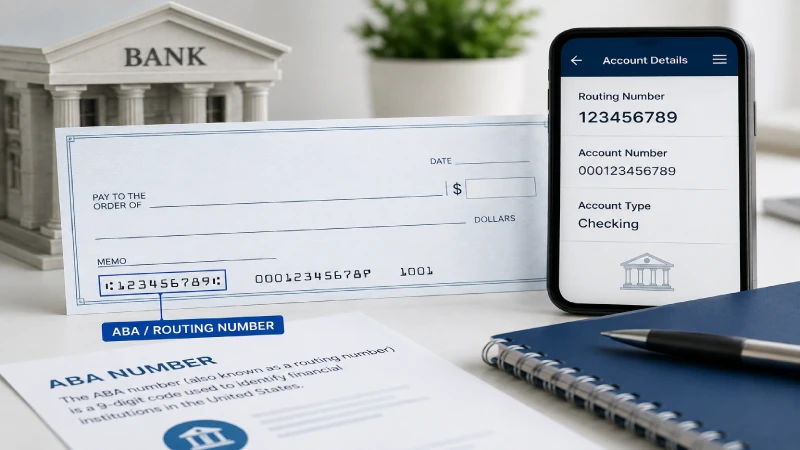
You are filling out a transfer form, and it asks for your ABA number. A few lines down, it asks for a routing number. Then there is a box for a SWIFT code, another for an IBAN, and a note warning that incorrect details may delay your payment.
If you have ever paused at that form and wondered whether you are being asked for four different things or the same thing four times, you are in good company. These identifiers trip up experienced people constantly, particularly anyone moving money between countries.
Here is the short version. An ABA number is a nine-digit code that identifies a specific bank inside the United States. It is what tells the payment system which institution should receive the money before the account number tells it which customer.
The confusion comes from the fact that “ABA number” and “routing number” usually describe the same nine digits, while SWIFT codes and IBANs do a similar job in a completely different context. Once you can tell them apart, transfer forms stop being intimidating.
This guide covers the ABA number meaning in plain language, where to find yours, when you actually need it, how it compares with SWIFT and IBAN, and the mistakes that cause payments to bounce back weeks later.
What Is an ABA Number?
An ABA number, also called an ABA bank number or ABA routing number, is a nine-digit code that identifies a financial institution in the United States. Every bank and credit union that processes payments has at least one.
The system dates back to 1910, when the American Bankers Association created it to solve a genuinely messy problem. Cheques were being sorted by hand, and bank names were long, similar, and frequently duplicated across states. A short numeric code made sorting faster and far less error-prone. Well over a century later, the same system underpins direct deposits, bill payments, and domestic wires.
The American Bankers Association still oversees the numbering scheme, with a designated registrar handling assignment. That matters because it means the codes are not arbitrary. The number encodes information about where the institution is based and how payments should route to it.
Think of it as a postal address for a bank. The ABA number gets your money to the right building, and the account number gets it to the right person inside.
Is an ABA Number the Same as a Routing Number?
Most of the time, yes. When someone says “routing number” in a US context, they almost always mean the ABA routing number.
| ABA Number | Routing Number | |
| Definition | Nine-digit code identifying a US financial institution | General term for the code that routes a payment to a bank |
| Usage | Cheques, ACH, direct deposits, domestic wires | Used interchangeably with ABA number in the US |
| Assigned by | American Bankers Association scheme, via its registrar | Same scheme in the US context |
| Domestic transfers | Yes, this is its primary purpose | Yes |
| International transfers | Limited, usually needs a SWIFT code alongside it | Limited, same restriction |
So why do banks list two different numbers on their websites?
Because many institutions maintain separate routing numbers for different payment rails. One number handles ACH transactions such as payroll and direct debits, while a different number handles domestic wire transfers. Both are ABA routing numbers. They simply route through different systems.
Large banks may also hold multiple ABA numbers assigned by state or region, usually a legacy of past mergers. If you opened your account in one state and now live in another, the number tied to your account is the original one, not the one for your current address.
Pro Tip: Before any wire transfer, ask the recipient for their wire routing number specifically rather than just “their routing number”. Sending a wire to an ACH-only routing number is one of the most common reasons transfers get rejected and returned days later, often with a fee attached.
Which Is the ABA Number on a Check?
Pull out a cheque and look along the bottom edge. You will see three groups of numbers printed in that distinctive magnetic ink.
The ABA routing number is the first group on the left, always nine digits, bracketed by two identical symbols. That is the one you need.
The account number sits next to it in the middle and identifies you personally. Its length varies by bank, typically somewhere between eight and seventeen digits.
The cheque number is the short number, usually three or four digits, matching the one printed in the top-right corner. Its position along the bottom varies between banks, which is exactly why people mix it up with the account number.
An easy way to remember which is the ABA number on a check: routing first, account second, and the short one is just the cheque’s serial number. If a number is nine digits and sits furthest left, it is your ABA number.
Of course, plenty of people no longer own a chequebook at all.
How Do I Find My ABA Number?
If you are wondering how do I find my ABA number without a cheque in front of you, there are several reliable routes.
- Online banking. Most banks display it under account details or account information once you are logged in.
- Mobile app. Usually found by tapping your account, then looking for account and routing details.
- Bank statement. Often printed in the account summary at the top of the first page.
- Official bank website. Many banks publish routing numbers by state, though you should confirm which one applies to your account type.
- Customer support. A phone call or branch visit settles it definitively, and this is the safest route if the number will be used for a large transfer.
One caution about the internet. Third-party sites listing routing numbers are frequently out of date, especially for banks that have merged or been acquired. Verify with your own bank rather than a search result, particularly when significant sums are involved.
When Is an ABA Number Used?
Think of the first day of a new job. Payroll hands you a form asking for your bank details, and the reason they need the routing number is simple. Without it, the payment system does not know which of thousands of US institutions should receive your salary.
You will need an ABA number for:
- Direct deposits from an employer or benefits provider
- ACH payments, the network handling most recurring electronic transfers
- Domestic wire transfers between US banks
- Automatic bill payments to utilities, lenders, and insurers
- Tax refunds deposited directly by federal or state authorities
- Receiving inbound international transfers, where it is paired with a SWIFT code
That last one matters more than people expect. If a family member is sending you money from overseas, your US bank will need both a SWIFT code (to identify the bank internationally) and your ABA number and account number (to place the funds correctly once they arrive).
ABA Number vs SWIFT Code vs IBAN
Here is an easy way to remember the difference. ABA numbers work inside the United States. SWIFT codes work between countries. IBANs identify individual accounts in the countries that use them.
| Factor | ABA Number | SWIFT / BIC Code | IBAN |
| Purpose | Identifies a US bank | Identifies a bank internationally | Identifies a specific account internationally |
| Countries | United States only | Worldwide | Europe, Middle East, parts of Asia and the Caribbean |
| Format | 9 digits | 8 or 11 letters and numbers | Up to 34 characters, starting with a country code |
| Domestic transfers | Yes, primary use | Rarely needed | Yes, in countries that use it |
| International transfers | Only alongside a SWIFT code | Yes, essential | Yes, where applicable |
| Typical use case | US payroll direct deposit | Sending money from India to a US bank | Sending money to a bank in Germany or the UAE |
Two points worth knowing. The United States does not use IBANs at all, so if a form demands one for a US account, something is wrong with the form. And India uses neither ABA numbers nor IBANs domestically, relying on IFSC codes internally and SWIFT codes for anything crossing a border.
Which Bank Identifier Do You Need? Quick Checklist
- Sending money between two US banks? ABA routing number and account number.
- Setting up payroll or a direct deposit in the US? ABA routing number.
- Sending money from abroad into a US account? SWIFT code plus ABA number and account number.
- Sending money to Europe or the UAE? SWIFT code plus IBAN.
- Sending money to India? SWIFT code and IFSC code for domestic Indian routing.
- Unsure whether it is ACH or wire? Ask the recipient’s bank which routing number applies.
Common Mistakes People Make
Common Mistake: Assuming your bank has only one routing number. Many people find a number on a search result, use it for a wire, and discover a week later that the transfer was rejected because it was the ACH number. Worse, some transfers succeed but arrive at the wrong branch entity after a merger. Confirm the exact number with your bank for the exact transfer type. It takes five minutes and prevents weeks of chasing.
The other errors that cause failed payments:
- Confusing SWIFT with ABA – They are not interchangeable, and an international transfer usually needs both.
- Transposing digits – A single wrong number can send funds to a completely different institution.
- Assuming every country uses ABA numbers – Most do not. It is a US-only system.
- Using old details after a bank merger – Acquired banks often retire routing numbers after a transition period.
- Mismatched name and account – If the account holder name does not match the account, compliance checks can hold the payment regardless of correct routing.
An incorrect ABA number typically means the payment is rejected and returned, which costs you days and sometimes a fee. In less common cases, funds reach a valid but unintended account, and recovering them depends on the cooperation of a bank and a stranger. Prevention is very much better than cure here.
Tips for Sending Money Safely
A few habits worth building, especially for larger or international transfers.
- Verify details directly with the recipient, ideally by phone rather than email. Payment redirection fraud works by intercepting emailed bank details and quietly changing one line.
- Confirm the transfer method before you start. ACH is cheaper and slower. Wires are faster and cost more. They may use different routing numbers.
- Ask what the total cost is, not just the headline fee. Intermediary banks can deduct charges mid-route, and the exchange rate margin is often larger than the visible fee.
- Check the exchange rate against the mid-market rate for anything crossing a border. This is where most of the real cost hides.
- Send a small test transfer first when setting up a new recipient for a large amount.
- Save every confirmation, including reference numbers. If something goes wrong, the trace request depends on them.
These principles apply to any transfer. When the money is coming from another country, though, there is usually more at stake than the routing details alone.
How Remittor Makes International Transfers Easier
For many people, the reason they suddenly need to understand their ABA number is that money is arriving from overseas. That is particularly true for NRIs receiving proceeds from a property sale or a wealth transfer out of India.
In that situation, the ABA number is genuinely the easy part. The difficult part sits on the India side: tax clearance, banking documentation, regulatory limits on outward remittance, and the tax collected at source that applies to transfers leaving the country.
Remittor works specifically on that problem. The cross-border money transfer service handles the compliance, banking coordination, and paperwork that repatriation from India requires, including structuring around outward remittance tax and single transactions of up to ₹8 crores. Rates are quoted upfront rather than discovered at settlement.
Where the funds come from a property sale, the NRI property sale service manages the transaction end to end, from buyer identification through legal handling and registration, with most clients completing the sale without travelling to India. Tax planning happens before the sale rather than as a refund claim afterwards.
The NRI services overview and the wider solutions page set out how the process works. For broader context on cross-border capital movement, the Annual NRI Wealth Report is worth a read, and client testimonials describe how transfers have gone in practice.
If you have a transfer coming and want the details checked before it moves, you can speak with an NRI advisor or join one of the NRI wealth events held across Canada.
Frequently Asked Banking Terms
| Term | What It Means |
| ABA Number | Nine-digit code identifying a US bank, used for cheques, ACH, and domestic wires |
| Routing Number | Everyday term for the same nine-digit code in the US banking system |
| SWIFT / BIC Code | Eight- or eleven-character code identifying a bank internationally |
| IBAN | International account number used across Europe and several other regions, not in the US |
| Account Number | Identifies your individual account within a specific bank |
| IFSC Code | Eleven-character code identifying a bank branch within India |
| ACH | US network handling batched electronic payments such as payroll and bill payments |
| Wire Transfer | Direct bank-to-bank transfer, faster and more expensive than ACH |
Frequently Asked Questions
What is an ABA number?
An ABA number is a nine-digit code identifying a US financial institution, used for cheques, direct deposits, and domestic transfers.
Is an ABA number the same as a routing number?
Usually yes. In the US, both terms describe the same nine-digit code, though ACH and wire routing numbers can differ.
Where can I find my ABA number?
Check the bottom-left of a cheque, your online banking account details, mobile app, bank statement, or contact your bank.
Which number on a cheque is the ABA number?
The first nine-digit group along the bottom-left edge, printed between two matching symbols before your account number.
Is an ABA number required for international transfers?
Only for money arriving into a US account, alongside a SWIFT code. It is not used for outbound international routing.
Can two banks have the same ABA number?
No. Each number identifies one institution, though a single bank may hold several numbers across regions or payment types.
What happens if I enter the wrong ABA number?
The transfer is usually rejected and returned within days, sometimes with a fee. Occasionally, funds reach an unintended institution.
What’s the difference between ABA and SWIFT?
ABA numbers route payments inside the United States. SWIFT codes identify banks internationally for transfers crossing borders.
Do all countries use ABA numbers?
No. ABA numbers are US-only. Other countries use IBANs, sort codes, IFSC codes, or their own national systems.
How can Remittor help with international transfers?
Remittor manages compliant repatriation of funds from India, handling tax structuring, banking documentation, and property sale proceeds end to end.
Final Thoughts
Knowing what an ABA number is removes most of the anxiety from bank transfer forms. It is a nine-digit code identifying a US bank; it is almost always the same thing as a routing number, and you will find it on the bottom-left of any cheque or inside your online banking details.
The rest follows from there. Use the ABA number for anything moving within the United States. Add a SWIFT code when money crosses a border. Reach for an IBAN only when the destination country actually uses one.
Above all, verify the details with the bank itself rather than a search result, and check which routing number applies to your specific transfer type. Most failed payments trace back to that one unverified assumption.
And if your transfer involves moving wealth out of India, the routing details are the simplest part of the journey. That is worth planning properly before the money starts moving.