Every cross-border payment, import invoice, and holiday budget runs into the same question: which currency, and at what value? Money does not travel abroad the way a parcel does; it gets converted, and the currency at each end decides what the transaction is worth.
A working knowledge of the currencies of the world is more practical than it sounds. You need three things about any currency: its name, its symbol and its three-letter code. This article sets out that reference by region, plus which currencies rank strongest and weakest and why values differ.
What Are the Currencies of the World?
A currency is the money a country or territory recognises for pricing goods, settling debts and making payments. Some belong to one nation; others are shared; the euro spans twenty countries, and several African states use CFA francs.
Three identifiers matter, and they are not interchangeable:
- Name: what the currency is called, such as the Indian rupee.
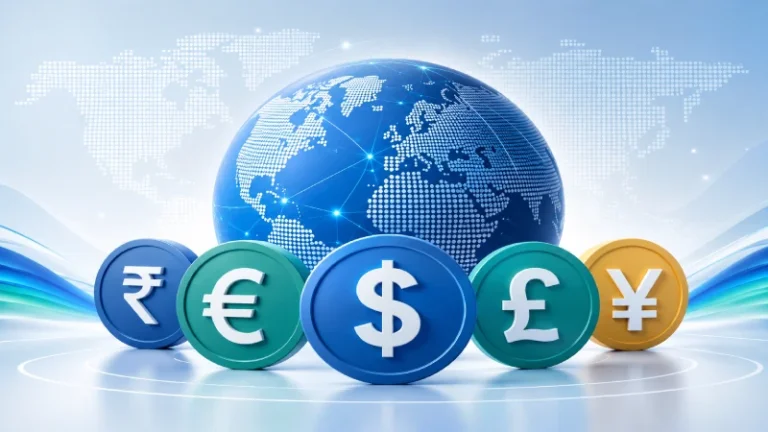
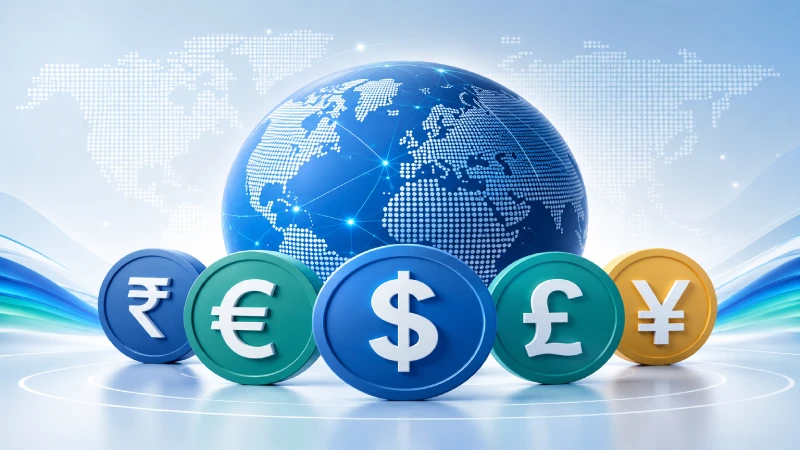
- Symbol: the shorthand used in prices: ₹, $, £, ¥, €.
- ISO 4217 code: a standardised three-letter code such as INR, USD or CHF, used by banks and forex systems worldwide.
The code removes ambiguity. Symbols repeat across borders; codes never do.
Complete List of World Currencies, Symbols and Codes
No single table holds all currencies in the world. This list of world currencies covers the major and most widely encountered ones; where a currency has no universally accepted symbol, the common abbreviation is shown.
| Country / Region | Currency | Symbol | ISO Code |
| United States | US dollar | $ | USD |
| Eurozone (20 EU members) | Euro | € | EUR |
| United Kingdom | Pound sterling | £ | GBP |
| Japan | Japanese yen | ¥ | JPY |
| India | Indian rupee | ₹ | INR |
| China | Renminbi (yuan) | ¥ / 元 | CNY |
| Switzerland | Swiss franc | Fr. / CHF | CHF |
| Canada | Canadian dollar | $ / C$ | CAD |
| Australia | Australian dollar | $ / A$ | AUD |
| Singapore | Singapore dollar | $ / S$ | SGD |
| South Korea | South Korean won | ₩ | KRW |
| Indonesia | Indonesian rupiah | Rp | IDR |
| UAE | UAE dirham | د.إ / Dh | AED |
| Saudi Arabia | Saudi riyal | ﷼ / SR | SAR |
| Kuwait | Kuwaiti dinar | د.ك / KD | KWD |
| Bahrain | Bahraini dinar | .د.ب / BD | BHD |
| Oman | Omani rial | ﷼ / RO | OMR |
| South Africa | South African rand | R | ZAR |
| Brazil | Brazilian real | R$ | BRL |
Major World Currencies
A handful of world currencies dominate international transactions: the US dollar, euro, pound sterling, Japanese yen, Swiss franc, Canadian dollar and Australian dollar. Their prominence comes from trade volume, market depth and reserve holdings rather than exchange-rate value. The dollar sits at the centre of commodity pricing and central bank reserves, which is why it appears on one side of most currency pairs.
Currency Symbols of the World
The currency symbols of the world are not unique, and that trips people up. The dollar sign covers the US, Canada, Australia, Singapore, and Mexico among others; the pound sign covers sterling and the Egyptian pound; several Gulf currencies share the riyal symbol.
A price written as “$500” is meaningless without knowing which dollar. When accuracy matters, use the ISO code.
Currency Codes Explained: What Do USD, EUR, GBP and INR Mean?
ISO 4217 codes follow a simple logic: the first two letters come from the country code, the third from the currency name: IN + R for the Indian rupee, GB + P for the pound, JP + Y for the yen. The euro, being multinational, is an exception.
Banks, forex platforms, and SWIFT messages all run on these codes. When you set up an international money transfer, the code routes the conversion correctly: INR to GBP is unambiguous in a way “rupees to pounds” is not.
World Currencies by Region
Grouping the currencies of the world geographically shows how much variation sits inside regions that look uniform from outside.
Currencies of Europe
The euro is used by twenty EU member states but not all of them. Sweden keeps the krona, Poland the złoty, Denmark the krone, and Hungary the forint; outside the EU, Switzerland uses the franc and Norway the krone. Britain retained the pound sterling throughout, which is why anyone planning to send money from India to the UK deals in GBP rather than EUR.
Currencies of Asia
Asia has the widest spread of any region. The yen, renminbi, Indian rupee, Singapore dollar and Korean won operate in very different systems, with nominal values ranging from the won, quoted in hundreds per dollar, to the Singapore dollar near parity.
Currencies of North and South America
The US dollar dominates, and several economies peg to it directly. Canada has its own dollar, which matters for anyone looking to send money from India to Canada; Mexico uses the peso. South America runs on the Brazilian real, Argentine peso, Colombian peso and Peruvian sol.
Currencies of Africa
Africa holds more distinct currencies than any other region: the rand, naira, Kenyan shilling, Egyptian pound, cedi and pula among them. Fourteen countries share two CFA francs, XOF in West Africa and XAF in Central Africa, both pegged to the euro.
Currencies of the Middle East and Oceania
Gulf currencies include the UAE dirham, used by anyone needing to send money from India to the UAE, the Saudi riyal for transfers to send money from India to Saudi Arabia, plus the Qatari riyal, Kuwaiti dinar, Bahraini dinar and Omani rial. Most are pegged to the dollar, which keeps rates stable.
Oceania is simpler: the Australian dollar, relevant if you send money from India to Australia, and the New Zealand dollar, with several Pacific nations using AUD.
What Is the Strongest Currency in the World?
“Strongest” needs defining before it means anything. It can describe four things: highest nominal value against the US dollar, greatest domestic purchasing power, most stability, or widest international influence. A currency can lead on one measure and rank nowhere on another.
By nominal value, the Kuwaiti dinar has held the top position for decades. As of 2026, one dinar is worth roughly US $3.28, ahead of the Bahraini dinar at about US $ 2.65 and the Omani rial at around US $2.60. Unlike most Gulf currencies, the dinar is not pegged directly to the dollar; since 2007, Kuwait’s central bank has linked it to an undisclosed weighted basket of currencies.
That does not make Kuwait the world’s strongest economy. The US dollar sits well down any nominal-value ranking yet remains the dominant reserve and trade currency, while the Swiss franc is treated as the most stable rather than the most valuable.
Strong Currency of the World: How Is Currency Strength Measured?
Several things feed into a strong currency of the world:
- Exchange-rate value: what one unit buys in foreign currency
- Inflation: low inflation preserves purchasing power
- Interest rates: higher rates attract capital
- Stability: economic and political confidence drives demand
- Reserves: the ability to defend the currency under pressure
A high exchange-rate value often reflects a small population, resource wealth and a managed peg rather than economic scale.
What Is the Weakest Currency in the World?
The weakest currency in the world usually means the one requiring the most units to buy a US dollar. Rankings shift, and the answer depends on which rate you use.
On market-based pricing, the Iranian rial is weakest by a wide margin, trading around a million rials per US dollar, while at official rates the Lebanese pound usually appears at the bottom. As of late July 2026, one dollar bought roughly 89,850 Lebanese pounds, a fall of about 98% since 2019. The Vietnamese dong, Lao kip and Indonesian rupiah also appear on these lists.
A low face value is not automatically a sign of crisis. Vietnam and Indonesia both run growing economies; their currencies sit low partly because zeros were never removed through redenomination, partly by policy. Treat any ranking as a snapshot tied to a date.
Strongest vs Weakest Currency: What Is the Difference?
| Factor | Strong currency | Weak currency |
| Exchange-rate value | High value per unit | Many units per dollar |
| Stability | Low volatility | Frequent sharp moves |
| Purchasing power | Generally preserved | Often eroded by inflation |
| International demand | Widely held and traded | Limited use outside home market |
Why Do Currency Values Differ Around the World?
Currency values move because demand for one currency relative to another keeps changing:
- Inflation erodes purchasing power and pushes a currency down
- Interest rates: higher rates draw foreign capital and lift demand
- Economic performance: growth and productivity shape confidence
- Political stability: uncertainty pushes investors elsewhere
- Trade flows: importing far more than you export adds pressure
- Market sentiment: expectations move rates before the data does
Pegged currencies behave differently. When a central bank fixes its rate to the dollar or euro, it commits reserves to holding that level, which is why several Gulf currencies barely move.
How Currency Exchange Works Between World Currencies
Converting between the currencies of the world means exchanging one for another at a rate reflecting what the market will pay. Hold rupees and need pounds, and you are buying GBP with INR.
The rate quoted publicly is the mid-market rate, the midpoint between buying and selling prices. What a bank or provider offers usually differs, because a margin is applied to a real cost, though not presented as a fee.
Why Exchange Rates Matter When Sending Money Abroad
On a small transfer, a slightly weaker rate is a rounding error. On a large one, it is the biggest single determinant of what arrives.
Two costs are worth separating. The exchange rate decides how much foreign currency your money converts into; the total transfer cost adds the sending fee, correspondent deductions and receiving-bank charges. Comparing on rate alone misleads, which is why a money transfer from India is best judged on the final amount received.
How to Read a Currency Pair
A currency pair such as USD/INR has two parts: the first currency is the base, the second the quote. The number shows how many units of the quote currency one unit of the base buys.
USD/INR at 88 means one dollar buys 88 rupees; reverse it to INR/USD, and you get the inverse. Check which currency comes first before any arithmetic; getting the direction wrong is the most common conversion error there is.
World Currencies and International Money Transfers
Knowing a currency’s name, symbol, and code stops being academic the moment you send money abroad. Transfer forms ask for the destination currency by code, and beneficiary details must match the account’s currency. A payment sent in the wrong one can be converted twice, or returned.
This is where Remittor works, helping individuals and NRIs with cross-border transfers from India, covering forex rates, documentation and compliance alongside the transfer.
Currency, Forex Rate and Transfer Cost: What Should You Check?
- The destination currency and its ISO code
- The exchange rate applied, against the mid-market reference
- The sending fee and any correspondent or receiving-bank charges
- Tax, compliance and documentation requirements for your route
- The final amount the recipient receives
Frequently Asked Questions About the Currencies of the World
How many currencies are there in the world?
Roughly 160 to 180, depending on how territories, pegged local currencies and non-circulating codes are counted. No single agreed figure exists.
What are the major currencies of the world?
The US dollar, euro, pound sterling, yen and Swiss franc, joined by the Canadian and Australian dollars and the renminbi. They dominate trade, reserves and forex volume.
What is the strongest currency in the world?
By nominal value against the dollar, the Kuwaiti dinar, at roughly US$3.28 in 2026. By stability or global influence, the Swiss franc or US dollar.
What is the weakest currency in the world?
On market rates, the Iranian rial; on official rates, usually the Lebanese pound. Rankings shift, so any answer needs a date attached.
Why do currencies have different symbols and codes?
Symbols developed locally and often overlap between countries. ISO 4217 codes exist precisely to remove that ambiguity in banking and forex.
Which currency is used for international money transfers?
It depends on the country and the route. Many transfers convert directly, though some corridors route through the US dollar as an intermediate currency.
A Practical Reference for Understanding World Currencies
Three things are worth carrying away from the currencies of the world. Every currency has a name, a symbol and a code; trust the code, because symbols repeat and names get translated. Currency strength is relative and time-bound: the Kuwaiti dinar leads on nominal value, the dollar on influence, and neither position is permanent. And once money crosses a border, the exchange rate and total transfer cost matter more than any of the theory.
That last point is where the practical work sits. If you are moving funds from India for family, education, property, or investment, know the destination currency, check the rate you are actually offered, and understand what documentation your route requires.