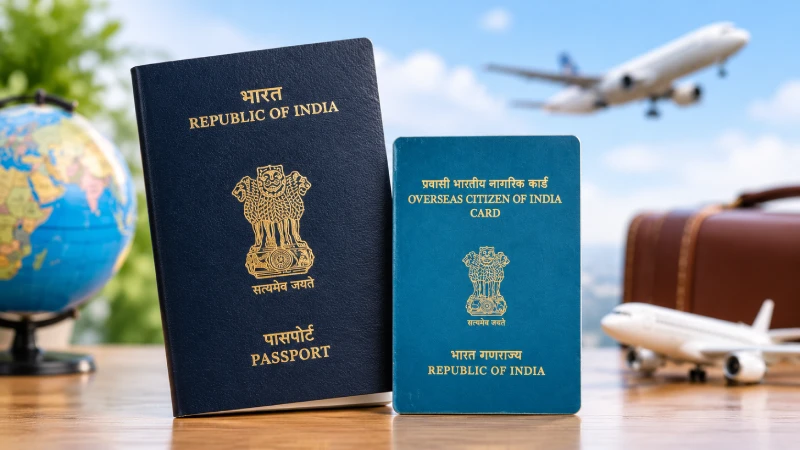
If you hold a foreign passport but your roots, or your parents’ or grandparents’ roots, are in India, an OCI card can make travel to India far simpler. The Overseas Citizen of India card is a lifelong visa for foreign citizens of Indian origin, issued by the Ministry of Home Affairs. This guide explains what an OCI card is, who is eligible, its benefits, the documents and photo rules, the online application steps, fees, timelines, and renewal rules.
What Is an OCI Card and What Is Its Full Form?
OCI stands for Overseas Citizen of India. It is a registration that lets eligible foreign nationals of Indian origin enter and stay in India on a multiple-entry, lifelong visa. The scheme has been in effect since 2 December 2005 under Section 7A of the Citizenship Act, 1955.
An OCI card is not Indian citizenship, and it is not dual citizenship. The Constitution of India does not allow a person to hold Indian and foreign citizenship together. The Ministry of Home Affairs states that a cardholder is a foreign national who holds a foreign passport, so the card is always used along with that passport.
Who Is Eligible for an OCI Card?
Under Section 7A, an adult foreign citizen can apply if any of these is true:
- They were a citizen of India on or after 26 January 1950, or were eligible to become one on that date.
- They belonged to a territory that became part of India after 15 August 1947.
- They are a child, grandchild or great-grandchild of such a person.
Minor children of these applicants qualify, and so do minors whose parents or one parent is an Indian citizen.
A foreign-origin spouse of an Indian citizen or of an OCI cardholder can apply once the marriage has been registered and has continued for at least two years before the application. Spouse applicants face prior security clearance and a mandatory personal interview.
One firm restriction applies. A person who, or whose parent, grandparent, or great-grandparent, is or was a citizen of Pakistan, Bangladesh, or another notified country is not eligible. Foreign military or police personnel, serving or retired, are also not eligible, subject to limited exceptions for compulsory conscription.
What Are the Benefits of an OCI Card?
The core benefit is a multiple-entry, multi-purpose lifelong visa to visit India. Cardholders are also exempt from FRRO or FRO registration for any length of stay, though those normally resident in India must email the jurisdictional officer about changes of address or occupation.
Other benefits include:
- Parity with Indian nationals on domestic air fares and entry fees at national parks, monuments and museums.
- Parity with NRIs for buying and selling non-agricultural property, adoption, entrance tests such as NEET and JEE against NRI seats, and practising as doctors, advocates, architects or chartered accountants.
- Eligibility for teaching posts at IITs, NITs, IIMs, IISERs, IISc, central universities and the new AIIMS.
The limits matter just as much. OCI holders cannot vote, stand for Parliament or state legislatures, or hold constitutional posts. They are not eligible for public employment unless the government specifies otherwise, and they cannot buy agricultural land, farmhouses, or plantation property. They need separate permission for research, journalism, missionary work, and visits to protected areas.
What Documents Are Required for an OCI Card?
Applicants upload documents online as part of the application, and originals are verified later at the Indian mission, VFS centre, or FRRO. The checklist depends on who is applying.
| Document | Adult (Indian origin) | Minor child | Foreign spouse |
| Valid foreign passport (at least 6 months validity) | Yes | Yes | Yes |
| Naturalisation or citizenship certificate | Yes | Yes | Yes |
| Surrendered Indian passport with surrender certificate (if surrendered in or after 2010) | Where applicable | Where applicable | No |
| Proof of Indian origin of self, parent or grandparent (Indian passport, domicile or nativity certificate, or other proof) | Yes | Parent’s proof | Spouse’s proof |
| Birth certificate showing both parents (apostilled if foreign) | For relationship proof | Yes | No |
| Parents’ marriage certificate, or reason if unavailable | Where relevant | Yes | No |
| Registered marriage certificate, translated or apostilled if issued abroad | No | No | Yes |
| Indian spouse’s passport, or OCI card and passport if the spouse is an OCI holder | No | No | Yes |
| Declaration to surrender the card on divorce, separation, or death | No | No | Yes |
| Address proof (utility bill or lease) | Yes | Yes | Yes |
If you apply from inside India, you also need a long-duration visa (not tourist, missionary, or mountaineering) with at least three months validity, plus the FRRO residential permit. Divorced parents of a minor must add the court order showing custody. Requirements can differ by mission, so match this list with the checklist for your country.
OCI Card Photo and Signature Requirements
Photo and signature files are the most common reason for upload errors. The Ministry of Home Affairs FAQ sets these basics:
- Square photo, not smaller than 51 mm x 51 mm, with the face covering about 80% of the frame.
- Plain light-coloured background that is not white, with no border or shadows.
- Front view of head and shoulders, eyes open, face centred, no tinted glasses. Head coverings are allowed only for religious reasons and must leave the face visible from chin to forehead.
- JPG or JPEG format, with equal width and height between 200 x 200 and 900 x 900 pixels.
- Signature image in JPG or JPEG with a 3:1 aspect ratio, between 200 x 67 and 900 x 300 pixels. A child who cannot sign gives a left thumb impression.
- Maximum file size of 200 KB for each image in the MHA FAQ.
Some mission and VFS checklists quote different pixel ranges and file-size limits, and the portal has been updated over time. Always check the current limits on the portal and your VFS or mission checklist before uploading. Babies under one year need not have their eyes open.
How to Apply for an OCI Card Online: Step-by-Step Process
Applications are accepted only through the official portal. Follow these steps:
- Visit https://ociservices.gov.in/ and read the instructions carefully before you start.
- Choose the application category, such as a new OCI registration or conversion of a PIO card to OCI.
- Fill in your personal, passport, family, and address details exactly as they appear on your documents.
- Upload the face photo, signature, and the category-wise supporting documents in the required format.
- Pay the applicable fee and submit the application. Save the registration number and the acknowledgement.
- Complete verification. Bring only the original documents to the Indian mission, VFS or BLS centre, or FRRO for checking, and give biometrics if asked.
- Track the application online until the OCI booklet is ready for collection.
Submission differs by country. Applicants abroad usually book an appointment at the Indian mission or its authorised VFS or BLS centre, while applicants living in India submit originals to the jurisdictional FRRO. Spouse-based applicants must also attend an interview, in person or by video.
OCI Card Application Fees and Processing Time
Fees depend on the country of submission, the type of application, and the service charges of the visa application centre. The Ministry of Home Affairs FAQ published in 2021 listed US$275 for a new registration at a mission and Rs 15,000 in India, and lower amounts for PIO-to-OCI conversion. Treat these as indicative only, because fee schedules are revised and local service charges apply.
The official indicative timeline is about 30 days from the date the application is acknowledged on the online system. That clock starts after you submit the originals and the mission or FRRO acknowledges the file. Appointment waits and verification can add several weeks, so many applicants plan for six to eight weeks overall. If registration is refused, the FAQ states that most of the fee is refundable, except a non-refundable processing charge.
How to Check OCI Card Application Status
Open the OCI portal, choose the status option, and enter your registration number and foreign passport number. Authorities advise checking after about five weeks from the acknowledgement date.
If the status looks stuck, first confirm that the acknowledgement was issued. If the mission or FRRO emails you about a deficiency, send the missing document to that office, which then uploads it to the system. For a long delay, write to the same office with your registration number, quoting the acknowledgement date.
OCI Card vs NRI Status: What’s the Difference?
The two terms are often mixed up, but they describe different things. An OCI card is an immigration status for foreign citizens, while NRI meaning and types in India relate to Indian citizens who live abroad.
| Point | OCI cardholder | NRI |
| Citizenship | Foreign citizen, not an Indian citizen | Indian citizen |
| Who qualifies | Foreign nationals of Indian origin and eligible spouses | Indian citizens living outside India |
| Passport | Foreign passport only | Indian passport |
| Residency test | Not based on days spent in India | Based on days spent in India each financial year |
| Travel to India | Lifelong multiple-entry visa | No visa needed |
| Voting | Not allowed | Allowed, if registered as an overseas elector |
| Agricultural land | Cannot buy | Cannot buy, but may inherit |
Since an OCI holder is a foreign citizen, the tax and exchange-control status that follows from time spent in India is worked out separately from the card.
Can OCI Cardholders Buy Property and Manage Finances in India?
OCI cardholders have parity with NRIs for buying and selling residential and commercial property. The Ministry of Home Affairs excludes agricultural land, farmhouses and plantation property, which an OCI cardholder cannot acquire. Rules on inherited property, repatriation limits and bank account types are set separately under FEMA, so confirm them before any transaction.
Holding an OCI card does not decide your income-tax residency. That depends on the number of days you spend in India in a financial year, and an OCI holder can be a resident or a non-resident for tax purposes in different years.
Identity documents are another common question. The OCI card is accepted as an identity proof in many places, and cardholders who have lived in India for 182 days or more in the previous 12 months can check the Aadhaar card eligibility rules for OCI holders before enrolling. An Aadhaar number is not needed to keep OCI status.
OCI Card Renewal and Passport Update Rules
An OCI card does not expire, but it is linked to your passport. Under the revised guidelines issued by the Ministry of Home Affairs in April 2021, most cardholders no longer need a fresh card every time the passport changes.
The current rules are:
- If your OCI was issued when you were 20 or younger, you must get the card re-issued once, when a new passport is issued after you turn 20.
- Up to age 20, upload a copy of each new passport and a latest photo online under OCI Miscellaneous Services.
- Upload the new passport and a recent photo once more after you turn 50.
- A foreign spouse registered under the spouse category must upload the new passport and photo every time one is issued, with a declaration that the marriage continues.
The online upload should be done within three months of receiving the new passport, and it updates the record without a new card. A re-issue is a full application that produces a new booklet, and it is also used for loss, damage, or changed personal details. Keep carrying your current passport, because the OCI card works only together with it.
FAQs About OCI Cards
What is the full form of OCI card?
OCI stands for Overseas Citizen of India, a lifelong visa for foreign nationals of Indian origin, granted by India’s government.
Who is eligible for an OCI card?
Former Indian citizens, descendants, minor children, and spouses married for two years can apply, except people with Pakistani or Bangladeshi ancestry.
Can a foreign spouse apply for an OCI card?
Yes, a foreign spouse of an Indian citizen or OCI holder can apply after two continuous years of registered marriage.
What documents are required for an OCI card?
Applicants need a passport, citizenship proof, proof of Indian origin, relationship documents, and address proof, plus a photo and signature.
What are the photo requirements for an OCI card?
Upload a square JPG photo of 200 to 900 pixels, on a plain light background not white, under 200 KB.
How can I apply for an OCI card online?
Register on ociservices.gov.in, fill the form, upload documents, pay the fee, then verify originals at your mission, VFS, or FRRO.
How long does it take to get an OCI card?
Officially, about 30 days after acknowledgement, though appointments and verification often stretch the total to six to eight weeks overall.
How can I check my OCI card application status?
Use the portal’s status option with your registration number and foreign passport number, ideally about five weeks after the acknowledgement.
Can OCI cardholders buy property in India?
OCI holders can buy and sell residential and commercial property in India, but not agricultural land, farmhouses, or plantation property.
Does an OCI card need to be renewed?
The card is lifelong; only cards issued before age 20 need one reissue, and other passport changes are updated online.
Ready to Apply for Your OCI Card? Check These Details First
Before you open the application, confirm that you fall under an eligible category and have no Pakistani or Bangladeshi ancestry in the family line. Collect the documents for your own category, whether adult, minor, or spouse, and translate or apostille anything issued abroad. Prepare the photo and signature to the current portal and VFS specifications. Then submit the application at ociservices.gov.in, book your document verification appointment, and keep your registration number safe for tracking.