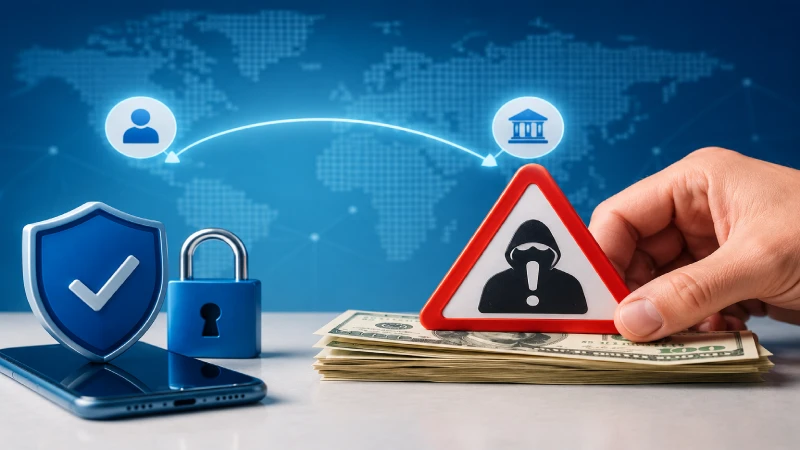
Your phone rings on a Tuesday afternoon. The caller says he is from your bank’s fraud department, and he sounds calm, official, slightly bored. He tells you someone has tried to withdraw a large sum from your account, and the only way to protect your balance is to move it right now into a “safe account” he will read out to you.
Most people freeze. Some argue. A surprising number simply comply, because the story sounds plausible and the clock is ticking.
That single call is the shape of almost every fraud you will read about below. Money transfer scams are rising fast, and international transfers are a favourite target because they move quickly, cross borders, and are hard to claw back once the funds land. Add international money transfer apps, instant settlement, and AI voice cloning to the mix, and criminals have never had better tools.
The good news: nearly every scam leaves fingerprints. Once you know what bank transfer fraud actually looks like, the signs become obvious. This guide walks through the most common tricks, the warning signs worth memorising, and the habits that keep your money where it belongs.
Why Money Transfer Scams Are Increasing
Three things changed in the last few years, and fraudsters noticed all of them.
Digital banking became the default. Sending money used to mean a branch visit, a form, and a clerk who might raise an eyebrow at an odd request. Now a transfer takes four taps and no human ever asks why.
Transfers got faster. Real-time payment rails such as UPI in India, Interac in Canada, and Faster Payments in the UK settle in seconds. Speed is wonderful for you and even better for someone who wants funds gone before you realise anything is wrong.
Social engineering got cheaper. Criminals rarely break encryption or hack a core banking system. That is expensive and difficult. Manipulating a worried human being is neither. AI voice tools can now clone a relative’s voice from a short social media clip, and spoofing software can make a call display your bank’s real helpline number.
Remember the principle behind almost every case of funds transfer fraud: the weak point is not the technology. It is the pressure applied to the person holding the phone.
The Most Common Types of Money Transfer Scams
Family Emergency Scam
You get a call or a message. A son has been in an accident. A nephew is in a police station in another city. A cousin is in hospital, and the surgery cannot start until a deposit clears. The voice is distressed, the details are vague, and the request is always urgent.
Red flags: the caller avoids questions only the real person could answer, insists you not tell anyone else in the family, and asks for a transfer to an account name that does not match the person in trouble.
Prevention: hang up and call your relative directly on the number you already have saved. If you cannot reach them, call someone else in the family. Sixty seconds of checking has saved a lot of people a lot of money.
Fake Bank Transfer Fraud
This is the scenario from the opening, and it remains the single most effective form of bank transfer fraud. Variants include a fake fraud department, a fake OTP verification call, a fake KYC update warning, and a fake “your account will be blocked today” SMS with a link.
Here is the rule that ends this scam every time: no bank, anywhere, will ever ask you to move your own money to a different account for safekeeping. Banks freeze accounts. They block cards. They do not ask customers to perform transfers on their behalf.
Would your bank really ask you to move your own money to protect it? Ask yourself that question mid-call and the spell usually breaks.
Prevention: end the call and dial the number printed on your debit card or in your official banking app. Never call back the number that contacted you.
Marketplace Scams
Facebook Marketplace, Craigslist, OLX, and local classified groups are full of genuine deals and a steady supply of fakes. Two patterns dominate. As a buyer, you pay in advance for an item that never ships and a seller who deletes the listing. As a seller, you receive a screenshot of a payment confirmation that never actually reaches your account, and you hand over the goods before checking your balance.
Prevention: confirm money has arrived in your account, not in a screenshot. For high-value items, meet in person and pay on delivery.
Investment Scam
Guaranteed monthly returns. Crypto arbitrage with “zero risk.” Forex signal groups with screenshots of enormous profits. Often the first small withdrawal works perfectly, which is exactly the point, because it convinces you to send a much larger amount.
Urgency is the tell. Legitimate investments do not expire in two hours. If someone is pushing you to transfer before a “window closes,” the window is the scam.
Romance Scam
These build slowly over weeks or months of daily conversation. The requests start small: a phone bill, a medical test, a customs fee on a gift being shipped to you. Each payment is framed as temporary and repayable. Because emotion is involved, victims often keep sending long after friends have raised concerns.
Prevention: be extremely cautious about sending money to anyone you have never met in person, no matter how well you feel you know them. A video call that never quite works out is a serious warning sign.
Employment Scam
A recruiter offers an overseas job with an attractive salary, then asks for a registration fee, a visa processing charge, a training deposit, or a refundable security amount. Genuine employers and licensed recruitment agents do not ask candidates to pay for a job offer.
Prevention: verify the company through its official website and phone number, and check whether the recruiter is registered with the relevant labour or emigration authority in your country.
Refund Scam
Someone claims they transferred money to you by mistake, or that a merchant overpaid a refund, and politely asks you to send it back. The original payment is often made with a stolen card or hacked account, and it gets reversed later. You end up out of pocket twice.
Prevention: never return funds directly. Report the unexpected credit to your bank and let them handle the reversal.
Warning Signs of Money Transfer Frauds
Most money transfer frauds share the same handful of signals. If two or more of these show up in one conversation, stop.
- Urgent requests with an artificial deadline
- Pressure to act before you can verify anything
- A request to keep the transaction secret from family or bank staff
- Odd grammar, mismatched names, or a slightly wrong domain in an email
- Calls or messages from unknown numbers claiming to be an official body
- Anyone asking for an OTP, PIN, CVV, or card details
- The phrase “transfer to protect your money” in any form
- Returns or offers that are far better than anything else available
- Payment links sent over WhatsApp, SMS, or email rather than typed by you
How to Avoid Money Transfer Scams
This is where habits matter more than knowledge. Build these into your routine, and most attempts fail before they start.
Verify the Recipient
Confirm the account number, name, and IFSC or SWIFT code directly with the recipient using a channel you already trust, such as a phone call to a saved number. Beneficiary details sent over email or chat should always be double-checked verbally, because business email compromise usually works by quietly altering one line of bank details in an invoice.
Never Share an OTP
A one-time password exists to prove that you, and only you, authorised a specific action. Anyone requesting it, including someone claiming to be from your bank, a delivery service, or a payment app, is trying to complete a transaction you did not intend. There is no legitimate exception to this.
Do Not Rush
Scams need speed to work, because thinking time is fatal to them. Give yourself a personal rule: any request involving money waits at least ten minutes before you act. Real emergencies survive ten minutes. Fake ones fall apart.
Use Trusted, Regulated Providers
Choose a provider that is licensed in the countries it operates in, uses encryption in transit and at rest, runs proper identity verification on both sender and recipient, and monitors transactions for unusual patterns. Regulated providers also give you a formal complaints route and an audit trail, which matters enormously if something goes wrong. If you are an NRI moving larger sums, look for a partner that understands compliance on both sides of the border, not just the transfer itself. Remittor’s work with NRI money transfers is a useful example of what that end-to-end handling looks like.
Double-Check Bank Details Character by Character
One wrong digit and the money reaches a stranger’s account, and recovery then depends on the goodwill of someone you cannot contact. Read the account number aloud in pairs, and use the small test transfer feature if your provider offers one.
Beware of Fake Customer Support
Search results and social media replies are full of fake helpline numbers placed there specifically to catch people in a panic. Only use contact details from the official app, the printed card, or the verified website. Never install remote access software such as AnyDesk or TeamViewer at the request of a “support agent.”
Avoid Public Wi-Fi for Financial Transactions
Open networks in airports, cafes, and hotels can be monitored or spoofed. Use mobile data or a trusted network when you log in to banking apps, and switch off automatic connection to open networks.
Turn On Two-Factor Authentication
Enable app-based two-factor authentication on your banking, email, and payment accounts. Email deserves special attention, because whoever controls your inbox can reset almost everything else.
Keep Apps and Devices Updated
Security patches close known vulnerabilities. Delaying updates for weeks leaves an open door that requires no social engineering at all.
What To Do If You Accidentally Scam Transfer Money
If you realise you have been tricked into a scam transfer, money can sometimes still be stopped, but only if you move fast. Work through these steps in order.
- Contact your transfer provider immediately – If the funds have not been paid out to the recipient, they may be able to halt or recall the transaction.
- Call your bank – Ask for the transaction to be flagged as fraudulent and request a recall through the relevant network.
- Freeze the account or card if you shared any credentials or if unauthorised activity has already appeared.
- Report the fraud officially – In India, file at cybercrime.gov.in or call 1930. In the UK, contact Action Fraud. In the US, report to the FTC and the FBI’s IC3. In Canada, contact the Canadian Anti-Fraud Centre.
- Change passwords on your banking, email, and payment accounts, starting with email.
- Monitor statements closely for at least the next few months, since details are often reused or resold.
- Keep every record – Screenshots, reference numbers, call logs, and message threads all strengthen your case with both the bank and the police.
Reporting quickly matters because many recovery mechanisms depend on reaching the receiving bank before the account is emptied. Hours count, sometimes minutes.
Safest Way to Send Money Without Getting Scammed
There is no single magic route, but there is a clear pattern. The safest way to send money without getting scammed is to use a licensed provider that verifies both ends of the transaction and gives you visibility at every step.
Look for these specific things before you send money abroad:
- Licensing and regulatory registration in the sending and receiving countries
- Recipient verification that checks the beneficiary name against the account, not just the number
- End-to-end tracking with a reference number you can follow until payout
- Fraud monitoring that flags unusual amounts, new beneficiaries, or odd timing
- Strong authentication on login and on every new payee
- Transparent exchange rates and fees disclosed before you confirm, with no vague “processing charges” appearing later
- Encrypted payments and secure document handling for KYC files
- A real human support channel you can reach through official contact details
Transparency is itself a security feature. When rates, fees, timelines, and compliance requirements are stated up front, there is nothing left for a fraudster to reinterpret in the gaps.
Best Practices Before Every International Transfer
Run this checklist every single time, even for a recipient you have paid before.
- Verify the recipient by voice, not by message
- Verify the account details character by character
- Verify the amount and the currency
- Check the exchange rate and total cost before confirming
- Refuse to act on urgency, however convincing
- Never share an OTP, PIN, or password
- Save the receipt and reference number
- Track the transfer until it is confirmed as received
- Confirm receipt with the recipient directly
Frequently Asked Questions
Can a bank transfer be reversed after fraud?
Sometimes, but it is not guaranteed. Reversal depends on how quickly you report, whether the funds have been withdrawn, and the policies of the receiving bank. Domestic transfers reported within hours have the best chance. Once money has been moved onward or converted, recovery becomes much harder.
What is bank transfer fraud?
It is any scheme where you are deceived into authorising a payment yourself, or where your account is used without your knowledge. Because you authorised the payment in most cases, banks treat it differently from card fraud, which is why prevention matters far more than cure.
How do scammers convince people to transfer money?
Through pressure, authority, and emotion. They create a deadline, borrow the identity of a trusted institution or person, and discourage you from verifying with anyone else. The story changes constantly, but that combination seldom does.
Are international transfers safe?
Yes, when handled through licensed providers with proper verification. Cross-border payments run on regulated networks and are monitored for suspicious activity. The risk usually sits in who you are sending to, not in the transfer channel itself.
Can I recover money from transfer fraud?
Recovery is possible but not assured. Report to your provider, your bank, and the relevant cybercrime authority immediately, and keep all evidence. Be very wary of “recovery agents” who contact you afterwards promising to retrieve lost funds for a fee, because that is a common second scam aimed at people who have already been defrauded.
Is UPI safer than a bank transfer?
Both are secure systems. UPI adds device binding and a PIN, while bank transfers give you a slightly longer window to spot an error before settlement. Neither protects you from authorising a payment to a fraudster, which is where nearly all losses actually happen.
How can I verify a recipient before sending money?
Call them on a number you already have saved and read the details back. For businesses, confirm bank details through an official phone number from their website rather than from the invoice itself. Use your provider’s beneficiary name check if one is available.
What are the limits on sending money out of India?
Resident individuals can remit up to USD 250,000 per financial year under the Liberalised Remittance Scheme, while NRIs repatriating funds fall under separate rules with a limit of USD 1 million per financial year from NRO accounts, subject to documentation.
What is the safest way to send money internationally?
Use a licensed, regulated provider, verify the recipient independently, avoid public Wi-Fi, enable two-factor authentication, and never act under time pressure. Those five habits prevent the overwhelming majority of losses.
Conclusion
Almost every victim of money transfer scams says the same thing afterwards: it felt urgent, and there was no time to check. That is not a coincidence. Urgency is the product being sold, and everything else is decoration.
So slow down. Verify the person, verify the account, verify the amount. Assume that any message pressuring you to move money immediately is false until you have confirmed otherwise through a channel you chose yourself. Ten minutes of checking costs you nothing. Skipping it can cost you years of savings.
Choosing a secure, transparent, and regulated money transfer platform with recipient verification and transaction tracking reduces your exposure to fraud and makes international payments far more predictable. If you are moving significant sums from India, particularly property proceeds or family support, it is worth speaking to an advisor who handles compliance, tax, and transfer as one process rather than three separate risks.